
The double-sided labeling machine utilizes a standard PLC + touch screen + standard sensor electronic control system. The human-machine interface features fully annotated Chinese text and comprehensive fault prompts and instructional features. It is easy to use and maintain, equipped with fault alarms, production counters, power saving functions, a production count setting reminder, and a no-label alarm. Comprehensive supporting documentation (including information on the machine structure, principles, operation, maintenance, repair, and upgrades) fully guarantees normal operation.
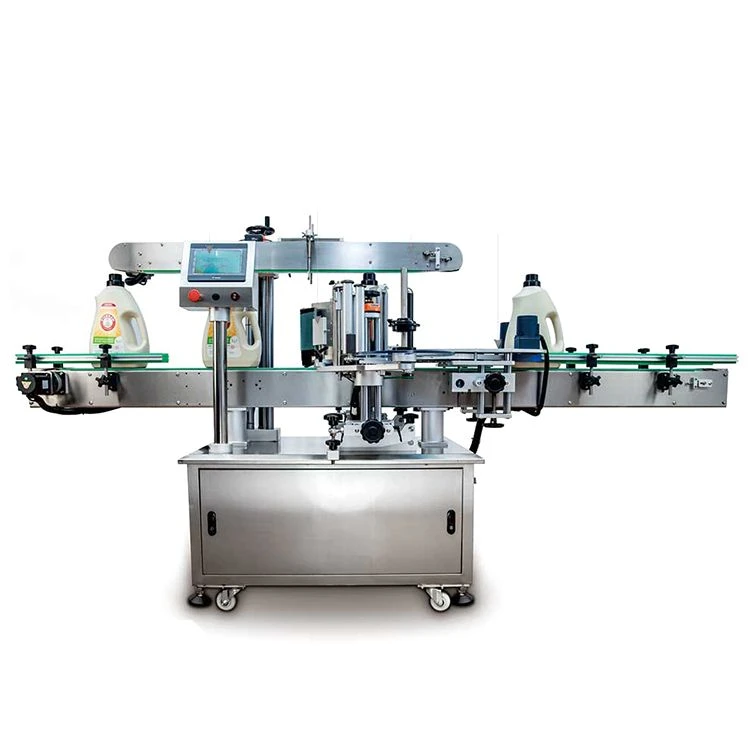
Application Areas of Double-Sided Labeling Machines:
1. Products requiring labeling on flat side surfaces, large curved side surfaces, circular surfaces, and square surfaces;
2. Widely used in industries such as food, toys, daily chemicals, electronics, pharmaceuticals, hardware, plastics, and printing;
3. Applicable labels: Self-adhesive labels, self-adhesive films, electronic monitoring codes, barcodes, etc., such as shampoo bottle labeling, lubricant bottle labeling, round shampoo bottle labeling, canned bottle labeling, and wine bottle labeling. Common Labeling Quality Issues and Solutions for Double-Sided Labelers
1: Vertical Wrinkles on Labels
Cause: Label delivery speed is too fast or the assembly line speed is too slow.
Solution: Slow down the label delivery speed or increase the assembly line speed (i.e., bottle feed speed).
2: Horizontal Wrinkles on Labels
Causes:
① Label delivery speed is too slow or the assembly line speed is too fast;
② The bottle shape is poor, resulting in a spherical shape being laminated.
Solution:
① Increase the label delivery speed or slow down the assembly line speed;
② Increase the scraper force or replace a good bottle. 3. Labeling is unstable when advancing or lagging.
Causes:
① The calibration mechanism is not properly calibrated;
② The bottle pressing mechanism is too loose or the scraper is scraping too hard, causing the bottle to deflect during labeling;
③ The line speed is too high;
④ The label puller is slipping;
⑤ The peel plate is too far from the bottle's surface;
⑥ The angle between the peel plate and the bottle's surface is too small;
⑦ The peel plate has already touched the bottle;
⑧ The scraper is too far from the peel plate opening, preventing the label from being immediately applied to the bottle;
⑨ The label tape is pressed too tightly. Solutions:
① Adjust the calibration mechanism to ensure accurate calibration of each bottle;
② Increase the pressure of the bottle pressing mechanism or reduce the force of the scraper to prevent the bottle from deflecting during labeling;
③ Reduce the line speed;
④ Tighten or replace the label puller;
⑤ Adjust the distance between the peel plate and the bottle's surface to bring it closer to the surface;
⑥ Increase the angle between the peel plate and the bottle's surface, then readjust the distance between the peel plate and the bottle's surface;
⑦ Adjust the distance between the peel plate and the bottle to avoid contact with the bottle;
⑧ Move the scraper closer to the peel plate opening to ensure that the label is immediately applied to the bottle;
⑨ Loosen the label pressing sponge wheel.
This concludes today's discussion of potential labeling quality issues with double-sided labeling machines and how to address them. I hope this will be helpful to you in your future use of this equipment.