

Why Choose Us?
Quality Assurance
Hangzhou Sanyou Intelligent Electromechanical Equipment Co., Ltd. is an automated mechanical equipment enterprise that integrates research and development, design, production, sales, and service.
Wide Range of Applications
Hangzhou Sanyou Intelligent Electromechanical Equipment Co., Ltd. is located in Yuhang District, Hangzhou, mainly producing and operating automated machinery and equipment --- labeling machines, which are widely used in pharmaceutical, food, chemical, electronics and other industries.
Custom Service
The company's main products include various types of standard fully automatic labeling machines and non-standard fully automatic labeling machines, and can also provide customized services according to the actual production situation of customers.
Production Market
Our crystal products are distributed throughout the country and exported to countries and regions such as Southeast Asia, Europe, and America. The product quality adopts tracking service, free maintenance during the warranty period, and lifelong maintenance.
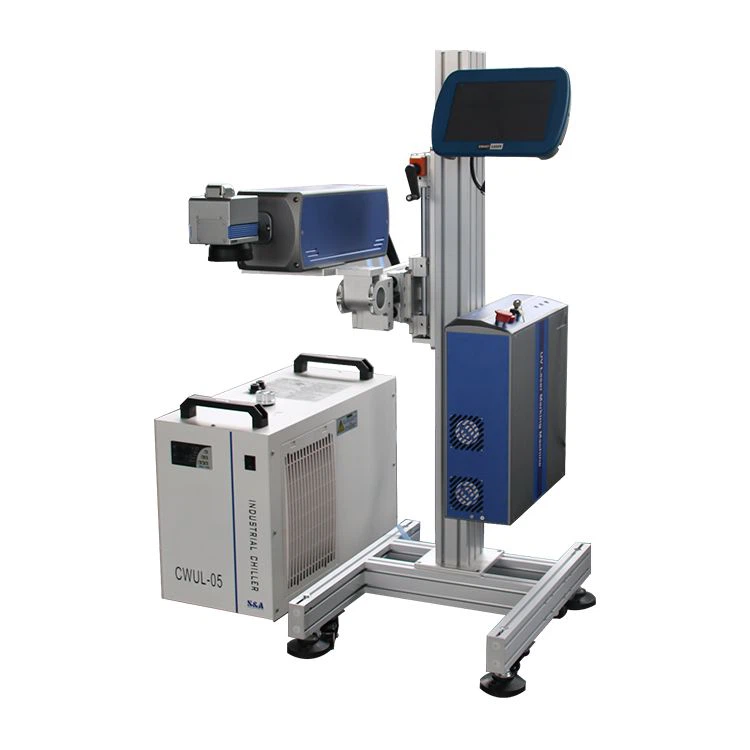
A UV laser coder, also known as a UV laser printer, is a type of industrial laser marking machine that relies on a UV laser to mark or print onto a substrate. As such, it eliminates the need for ink ribbons and thermal pads associalted with traditional thermal transfer overprinters and their costs.

It has the characteristics of high electro-optical conversion rate, long service life of nonlinear components, stable operation of the whole machine

CO2 laser is a gas laser with a wavelength of 106m, belonging to the mid infrared frequency band.

It has the characteristics of high electro-optical conversion rate, long service life of nonlinear components, stable operation of the whole machine

Through USB/SD/communication and other interfaces for data communication, the white tape coding software provides more comprehensive and convenient functions.

Using fiber laser output laser and then through the ultra-high-speed scanning galvanometer system to achieve the marking function the key components

Handheld Laser Marking Machine
It has the characteristics of high electro-optic conversion rate, long service life of nonlinear crystal, stable operation of the whole machine

It has the characteristics of high electro-optical conversion rate, long service life of nonlinear crystals, stable operation of the whole machine

Adopting a two-point focusing assist system, this function can help operators quickly find the coding focal length when replacing coding products.

UV laser coding machine is tailor-made for customers to improve production efficiency. High availability makes production faster and more convenient,
Benefits of UV Laser Printer
Cold working
Ultraviolet laser processing technology is the characteristics of the interaction between the laser beam and the material to cut, weld, surface treatment, punch and micro-machining materials (metals and non-metals).
Because it is not thermal ablation, but cold peeling that does not produce "thermal damage" side effects and breaks chemical bonds, it does not produce heating or thermal deformation on the surface of the processed material. This characteristic of almost no damage to the material makes the application range of UV laser coding machine wider than that of fiber laser printers and CO2 laser printers. The coding work on thin and light materials is its strength.
The coding is more precise
Among the laser printers, the wavelength of the UV laser printer is 355nm, and the wavelength of the fiber laser printer is 1064nm. Compared with fiber laser printers and CO2 laser printers, UV laser printers have a shorter wavelength.
Compared with the long-wavelength laser, the short-wavelength laser can obtain a smaller focused spot, and can perform very fine processing that is difficult to achieve in ordinary processing. Due to the short wavelength, small focusable spot, small heat-affected area, flexible and convenient processing, etc., ultraviolet laser is widely used in fine processing.
No consumables, low cost, no pollution
Before the advent of laser inkjet printers, the traditional coding methods used ink jetting, which resulted in a large amount of ink consumables and a high cost of marking and coding. With the popularity of online laser printers, the inkjet printers used in many industries have been gradually updated to laser printers.
The UV laser coding equipment uses the principle of breaking the chemical bond of the material by the UV laser beam for marking, so no consumables are produced in the daily operation, which greatly reduces the coding cost of the enterprise. The non-toxic and non-polluting characteristics of UV laser coding also make it favored by many companies today, which pays more and more attention to environmental protection.
Different materials have a wide range of optic properties. These differences can cause the same laser to interact with various materials in unusual ways. Most of the time, people require their lasers to etch or mark opaque materials. When someone needs to mark a translucent or transparent material, they must do a little extra work to make their laser perform properly.
Because translucent materials allow light to pass through them, scattering the light, laser marking can get a bit tricky. One thing you can do is to add a dark layer beneath your translucent material and recalibrate the working distance of the laser.
Additionally, the color of your material may come into play when marking. For example, black acrylic is easier to mark than green acrylic. That's because black materials absorb all light while green materials absorb all but green wavelengths. This slight difference can change the UV laser marking time of your project.
How to Clean Wood After UV Laser Printer?
After laser engraving, you will often see debris left over, and you'll want to clean this up to ensure your products look clean and ready for customers. To clean wood after laser engraving, start by gently brushing away any loose debris or soot from the surface using a soft-bristled brush or a can of compressed air. For more stubborn residue, lightly dampen a soft cloth with water or a mix of water and mild dish soap, then wipe the wood in the direction of the grain to prevent damage.
When cleaning, you'll want to avoid soaking the wood to prevent warping or swelling. If needed, use isopropyl alcohol on a cotton swab for tougher grime, but test on an inconspicuous area first to ensure it doesn't affect the finish. Once clean, dry the wood completely with a clean, soft towel. If desired, finish by applying a suitable wood polish or oil to enhance the wood's natural beauty and protect the engraving. For more tips on improving the finished result of your wood laser projects, see our post, How to Create a Darker Effect with Laser Engraving.
Laser coding machines were not the choice of coding. The past systems mainly had many disadvantages.
Laser coding machines included high procurement costs, large and heavy equipment, difficult installation, high maintenance costs for IC automatic laser marking machines, and laser safety. High, however, nowadays, the defects of the old laser printing system have been replaced by advanced technology and new laser coding machine systems, more and more companies are paying attention to and using laser coding machines, they have begun to realize that laser Coding machines can bring many benefits, such as: no consumables, no maintenance costs, less system downtime, environmental protection, etc.
The working principle of the laser coding machine is to collect laser light with a very high energy density on the surface of the object to be marked, burn the surface of the object by burning and etching, and burn the laser beam accurately by controlling the effective displacement of the laser beam to engrave the pattern or text.
According to different forms of identification, laser coding machine equipment can be divided into two types: scribing and dot matrix. Remaining technology, the laser coding machine mainly marks the track of the character to be marked, and the dot matrix laser machine marks some important track points of the character to be recognized. Therefore, under the same energy, the new dot matrix laser encoder prints more quick.

How Many Years Can a UV Laser Printer Marking Machine Be Used?
The number of years a UV laser marking machine can be used is related to many external factors, such as the working environment. Here to exclude external factors to say how many years a laser marking machine can be used.
The effective light-emitting time of a UV laser is 12,000 to 14,000 hours. According to the average used power and working time, the effective working time of the ultraviolet laser is 2 to 3 years.
When we use a new machine, it is not necessary to turn on the power of the machine to the maximum. For example, when the new equipment starts to work, the laser power can be set to 50%, and the speed is 500. Change according to usage.
How Deep Can You UV Laser Printer Engrave?
Close-up view of deep engraving on steelWhen it comes to deep engraving, the depth can easily reach a few millimeters into metals. This is in stark contrast with regular laser engraving, which is typically only a few microns deep.
But regular laser engraving can also be deep-up to 500 microns. This is often the case with shotblast resistant laser marking.
The real difference between deep engraving and laser engraving is that deep engraving comes with depth and aesthetic requirements. On the other hand, laser engraving requires a high contrast to meet traceability requirements-just like laser etching.
What Materials Can You UV Laser Printer Engrave?
One of the reasons UV laser engraving and marking are so popular is because you can use them on a wide range of materials. Metals are common, but you can also engrave and mark things like plastics, glass and wood. Here are a few examples of UV laser-engravable materials:
Metals: Almost any metal can be engraved, including steel, aluminum, iron, silver and gold. Since engraving stands up to post-processing, you can treat metals for a wide range of purposes and appearances after cutting. Some metals require higher temperatures for vaporization, so you'll want to consider your metal when choosing a laser machine.
Plastics: Plastics, like acrylic and polyoxyethylene (POM), are used in a wide variety of engravable and markable products thanks to versatile colors and physical characteristics.
Plywood and Medium-density Fiberboard (MDF): These wood products offer natural, light-colored appearances and respond well to engraving and marking.
Glass: Many types of glass can be engraved and etched for stunning effects that are great for product packaging and promotional materials.
Leather: Leather is tough and doesn't always respond well to mechanical engraving methods, but lasers cut through it quickly.
Stone: You can even use laser marking tools on stone, which might be used for outdoor projects like carving a logo into a walkway tile.
Tips for Maintaining Your UV Laser Printer
Create a Routine
The best way to maintain any sort of heavy equipment is by creating an inspection routine. Ensuring you regularly inspect your laser marking machine can help prevent damages and other operational issues. Using the included resources, such as manuals, give your device a thorough check-up before and after use. Look for anything out of the ordinary, like broken and/or misaligned parts or components. If you're unsure of anything concerning this routine inspection, it's best to contact the distributor for more information. Their expert advice can save you hours of labor and ensure successful solutions that don't cost a fortune.
Use Proper Techniques
Industrial laser marking machines are complex and require proper operating procedures to ensure success and reduce the likelihood of functional problems. Even though these devices are very hands-off regarding human labor, you still must always operate the machines correctly. Training is obviously important as it can help you identify issues before they get out of hand, helping extend the lifespan of your device.
Reeducation is another way to ensure you always use proper operating procedures. We recommend reviewing workplace and operation standards every few months to keep them fresh and at the top of your mind. By committing to perfection and thoughtfulness while working, your laser marking equipment will remain functional for years to come.
Clean Often
When we say "clean often," we mean often. You should conduct a quick cleaning before and after each and every use of your device. The most important thing to do each time is clean the lens as it is an essential component that gets dirty quickly. Turn off your equipment before cleaning the lens to avoid accidental injuries.
Be thorough but not too aggressive as these objects are fragile and can be damaged with improper techniques. You may need to remove a lens during this process, so ensure you handle the part with care. Aside from lens maintenance, wipe off any debris on your laser marking machine when possible. By cleaning every day, you can increase the functionality and lifespan of your equipment significantly.
Our Factory
Hangzhou Sanyou Intelligent Electromechanical Equipment Co., Ltd. is located in Yuhang District, Hangzhou, mainly producing and operating automated machinery and equipment --- labeling machines, which are widely used in pharmaceutical, food, chemical, electronics and other industries.

Our Certificate


Ultimate FAQ Guide to UV Laser Printer
Hot Tags: uv laser printer, China uv laser printer manufacturers, suppliers, Self adhesive Labeling Machine, Labeling Machine for Bottles, labeling category, Double Side Sticker Labeling Machine, Explosion proof Labeling Machine, Carton Labeler


